

This squeezing process needs a lot of force and energy. It happens constantly. Oil-lubricated or oil-free types both create heat. This heat exists because energy doesn't disappear. Because of this heat, compressors need lubrication and cooling. Without it, parts get too hot. They can warp, wear out, or break.
This means even oil-free air compressors use oil. They need oil to lubricate their moving parts. The oil also takes away heat caused by friction.
So why are they called "oil-free"? The key is the compression stage. Oil doesn't touch the air stream during compression. The name "oil-free" mainly distinguishes them from oil-injected screw compressors.
Compared to lubricated compressors, oil-free types let much less oil mix with the compressed air. Oil-injected types might use oil equal to 1% of the air they move.
Even so, an oil-free air compressor isn't 100% oil-free. It still needs oil for mechanical lubrication. This oil is a possible source of air pollution. It applies to every air compressor, including oil-free versions.
Oil-Free vs. Class 0
Marketing around oil-free scroll air compressor can confuse users about the air quality they'll actually get. Some sellers claim their "oil-free" compressors deliver Class 0 air, meaning it's completely oil-free. But this claim isn't entirely accurate. Class 0 doesn't mean zero oil.
Look at the standards – both the international one (ISO 8573-1:2010) and the Chinese one (GB/T 13277.1-2008). These standards define the oil purity classes. They clearly state that Class 0 means the user or manufacturer sets requirements stricter than Class 1. It does not mean anything below Class 1 is Class 0. It definitely doesn't mean absolutely oil-free.You could think of Class 0 this way: it only makes sense if the air has less oil than Class 1 allows, and meets the specific, stricter limits the user needs. If a manufacturer simply declares Class 0, it only means their oil level is technically better than Class 1. Why? Because the standards define Class 1 as having less than or equal to 0.01 mg/m³ of total oil. They don't set a minimum level for Class 1 or a maximum for Class 0.
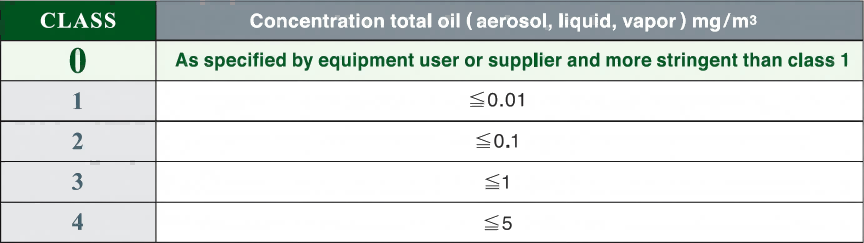
So, an oilless air compressor alone can't guarantee air free from oil contamination. Also, getting rid of all impurities in compressed air – like solid particles, water, and oil – is practically impossible in real-world industry. It's like trying to create a perfect vacuum.
Does this mean the term "oil-free" is useless?
Not at all. In practice, the goal usually isn't to remove every single trace of oil. It's about removing as much as possible while being realistic and cost-effective.
In this context, "technically oil-free air" means air with a very low total oil content. For example, air measuring just 0.003 mg/m³ after an activated carbon filter can be called technically oil-free. So, "oil-free" is relative. When the oil level gets low enough, we can call it oil-free. It's similar to calling an operating room "sterile" – it doesn't mean absolutely zero germs, just a level safe for surgery.