

The frequency converter, also known as variable speed drive, ac drive, variable voltage variable frequency or variable frequency drive, is a power electronic exchange device that converts the fixed rated AC power from the mains grid into variable voltage and frequency power suitable for AC motor speed regulation.
Working Principle
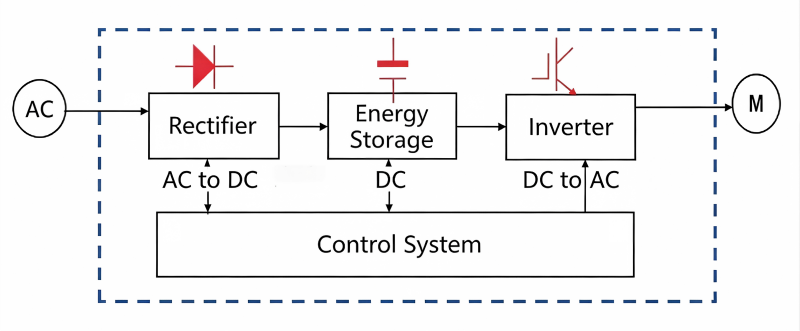
The main circuit of a frequency converter typically consists of three main parts: rectification, filtering, and inversion, realizing AC-DC-AC power conversion.
Rectification Process (AC-DC)
The input AC power is rectified into pulsating DC power by a diode rectifier bridge.
DC Filtering Process
The DC power enters the DC intermediate circuit and is filtered by capacitors and smoothing inductors to obtain a relatively stable DC voltage. This step also stores some energy to cope with load changes during motor operation.
Inversion Process (DC-AC)
The stable DC power is converted into AC power by IGBTs under the control of a microprocessor.
Motor Control Methods
When achieving speed regulation of a motor, necessary measures must be taken to ensure that the motor speed and torque meet the requirements of the equipment.
V/F Control
Directly controls the output voltage and frequency; performance is not high, but it is insensitive to motor parameters and suitable for speed regulation applications where high precision is not required.
Vector Control(VC)
Decouples the current into excitation current and torque current, allowing for more accurate control of the motor output and better adaptation to different load conditions, suitable for high-end applications. The disadvantage is its sensitivity to motor parameters; in practical applications, rotor flux linkage may be difficult to observe due to various reasons, leading to a significant difference between actual and theoretical results.
Direct Torque Control (DTC)
Directly controls the stator current, simplifying mathematical calculations. It is relatively less sensitive to motor parameters and vector control, but may produce torque and flux linkage pulsations.
V/F control, vector control, and DTC each have their advantages and disadvantages. In practical applications, the appropriate control method should be selected based on factors such as motor characteristics, required output, and load conditions.
In conclusion, the frequency converter achieves smooth and efficient speed control of AC motors through three main stages: rectification, filtering, and inversion, utilizing VF control and VD control. Understanding the principles of the variable frequency drive and motor control methods is crucial for accurately selecting and matching different loads, and fully leveraging equipment performance.