

What can laser cutting do?
It is widely used in many fields. These include sheet metal processing, metalworking, advertising sign production, kitchenware, automotive parts, light fixtures, saw blades, elevator manufacturing, metal crafts, textile machinery, food processing equipment, eyewear production, aerospace, medical devices, and instruments. Laser cutting machines mainly use methods like melt cutting, vaporization cutting, oxygen cutting, scribing, and controlled fracture cutting.
Laser cutting machines can handle various materials and complex shapes. Besides a high-energy laser, auxiliary gas is essential in the cutting process. The gas helps with burning and cooling. It also blows away molten residue quickly, which prevents dust from blocking the laser nozzle. Another important role is to protect the focusing lens and extend its service life.
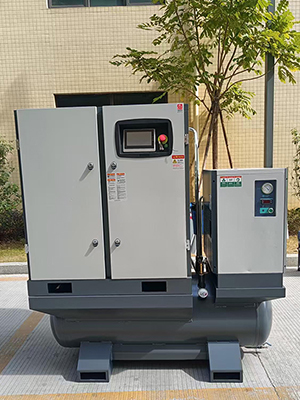
How to choose an air compressor for laser cutting?
When adopting compressed air as the auxiliary gas for laser cutting, the performance of industrial compressor serves as the core guarantee of stable cutting operation. Three key factors must be considered: pressure, flow rate, and air quality.
Pressure:
How thick a material a laser cutter can cut mainly depends on the laser power. Air pressure alone does not determine the cutting thickness. When the laser power is high enough, higher air pressure leads to better cutting quality and higher efficiency.
Flow Rate
Flow‑rate refers to the air volume supplied to the cutting nozzle. Sufficient steady‑going airflow blows molten slag and fumes off the kerf, obtaining clean, burr‑free cut edges.
Required airflow changes with laser power, nozzle diameter and metal thickness. Over‑spec your compressor free‑air‑delivery with spare capacity for pipe losses.
Air quality:
The quality of compressed air directly affects the cutting results. If the air contains water or oil, these can be sprayed onto the protective lens of the laser cutting head. This will disturb the laser beam, scatter the focus, and cause incomplete cuts. Defective products may result. In high-power laser cutting, it could even damage the laser head. Therefore, clean and dry compressed air is very important. Choosing an oilless air compressor can eliminate oil and gas pollution at the source. To remove water vapor, a good refrigerated dryer is needed. To filter out dust, high-precision filter units should be installed.