

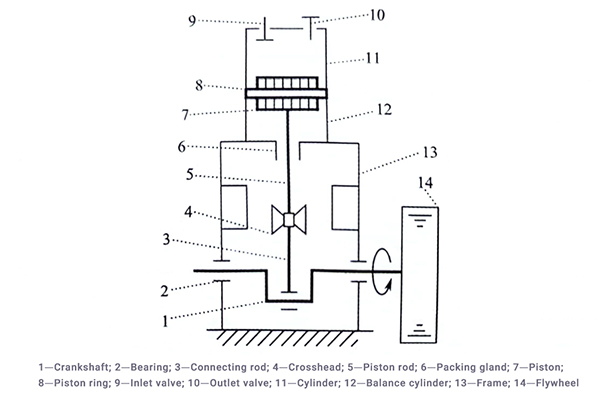
A single-stage piston type air compressor, also commonly known as piston compressor, reciprocating compressor, adopts a classic reciprocating motion structure, and its complete equipment structure is shown in the diagram. As a typical reciprocating piston compressors device, its core operation relies on mechanical linkage to realize gas compression.The engine turns the flywheel, which rotates the crankshaft (1). The crank on the shaft moves the big end of the connecting rod (3) in a circular motion. This motion is passed through the rod to its small end, driving the crosshead (4), the piston rod (5), and the piston (7) back and forth in a straight line.
Operating Cycle
When the piston moves from the outer dead center toward the inner dead center, the space between the cylinder head and the piston grows. The gas inside expands and its pressure drops. Once the pressure falls below the pressure in the inlet pipe, the suction valve opens. Gas enters the cylinder. The piston reaches the inner dead center and the suction valve closes. The entire suction stage of the piston type air compressor is completed.
Next, the piston moves toward the outer dead center. The space in the cylinder becomes smaller. The gas is compressed and its pressure rises. When the pressure exceeds the pressure in the outlet pipe, the discharge valve opens. Gas is pushed out. The piston arrives at the outer dead center and the discharge valve closes.
In this way, each full turn of the crankshaft moves the piston back and forth once. The compressor completes one full cycle. This cycle includes expansion, suction, compression, and discharge.